
Bahá’í Marriage and Family Life/II. Preparation for Marriage
| Bahá’í Marriage and Family Life II. Preparation for Marriage |
 Proofread once |
II. PREPARATION FOR MARRIAGE
[edit]A. Self-Knowledge
[edit]44. “O My servants! Could ye apprehend with what wonders of My munificence and bounty I have willed to entrust your souls, ye would, of a truth, rid yourselves of attachment to all created things, and would gain a true knowledge of your own selves – a knowledge which is the same as the comprehension of Mine own Being. Ye would find yourselves independent of all else but Me, and would perceive, with your inner and outer eye, and as manifest as the revelation of My effulgent Name, the seas of My loving-kindness and bounty moving within you.”
of Bahá’u’lláh, pp. 326-327)
45. “Far, far from Thy glory be what mortal man can affirm of Thee, or attribute unto Thee, or the praise with which he can glorify Thee! Whatever duty Thou hast prescribed unto Thy servants of extolling to the utmost Thy majesty and glory is but a
[Page 16] token of Thy grace unto them, that they may be enabled to ascend unto the station conferred upon their own inmost being, the station of the knowledge of their own selves.”
46. “…man should know his own self, and recognize that which leadeth unto loftiness or lowliness, glory or abasement, wealth or poverty.”
B. Choosing a Marriage Partner
[edit]47. “O SON OF SPIRIT!
“I created thee rich, why dost thou bring thyself down to poverty? Noble I made thee, wherewith dost thou abase thyself? Out of the essence of knowledge I gave thee being, why seekest thou enlightenment from anyone beside Me? Out of the clay of love I molded thee, how dost thou busy thyself with another? Turn thy sight unto thyself, that thou mayest find Me standing within thee, mighty, powerful and self-subsisting.”
48. “Disencumber yourselves of all attachment to this world and the vanities thereof. Beware that ye approach them not, inasmuch as they prompt you to walk after your own lusts and covetous desires, and hinder you from entering the straight and glorious Path.”
49. “O SON OF BEING!
“Bring thyself to account each day ere thou art summoned to a reckoning; for death, unheralded, shall come upon thee and thou shalt be called to give account for thy deeds.”
[Page 17] 50. “O MY SON!
“The company of the ungodly increaseth sorrow, whilst fellowship with the righteous cleanseth the rust from off the heart. He that seeketh to commune with God, let him betake himself to the companionship of His loved ones; and he that desireth to hearken to the word of God, let him give ear to the words of His chosen ones.”
51. “Consultation bestoweth greater awareness and transmuteth conjecture into certitude. It is a shining light which, in a dark world, leadeth the way and guideth. For everything there is and will continue to be a station of perfection and maturity. The maturity of the gift of understanding is made manifest through consultation.”
52. “Now speak forth with fairness. Do not misrepresent the matter, neither to thyself nor to the people.”
53. “As for the question regarding marriage under the Law of God: first thou must choose one who is pleasing to thee, and then the matter is subject to the consent of father and mother. Before thou makest thy choice, they have no right to interfere.”
of ‘Abdu’l-Bahá, p. 118)
54. “The love which exists between the hearts of believers is prompted by the ideal of the unity of spirits. This love is attained through the knowledge of God, so that men see the Divine Love reflected in the heart. Each sees in the other the Beauty of God reflected in the soul, and finding this point of similarity, they are attracted to one another in love. This love will make all men the waves of one sea, this love will make them all the stars of one heaven and the fruits of one tree. This love will bring the realization of true accord, the foundation of real unity.
[Page 18] “But the love which sometimes exists between friends is not (true) love, because it is subject to transmutation; this is merely fascination. As the breeze blows, the slender trees yield. If the wind is in the East the tree leans to the West, and if the wind turns to the West the tree leans to the East. This kind of love is originated by the accidental conditions of life. This is not love, it is merely acquaintanceship; it is subject to change.
“Today you will see two souls apparently in close friendship; tomorrow all this may be changed. Yesterday they were ready to die for one another, today they shun one another’s society! This is not love; it is the yielding of the hearts to the accidents of life. When that which has caused this ‘love’ to exist passes, the love passes also; this is not in reality love.”
55. “O thou son of the Kingdom! If one possesses the love of God, everything that he undertakes is useful, but if the undertaking is without the love of God, then it is hurtful and the cause of veiling one’s self from the Lord of the Kingdom. But with the love of God every bitterness is changed into sweetness and every gift becometh precious. For instance, a musical and melodious voice imparteth life to an attracted heart but lureth toward lust those souls who are engulfed in passion and desire.”
56. “It is extremely difficult to teach the individual and refine his character once puberty is passed. By then, as experience hath shown, even if every effort be exerted to modify some tendency of his, it all availeth nothing. He may, perhaps, improve somewhat today; but let a few days pass and he forgetteth, and turneth backward to his habitual condition and accustomed ways.”
57. “But thou must submit to and rely upon God under all conditions and He will bestow upon thee that which is conducive to thy well-being. Verily He is the merciful and compassionate! For
[Page 19] how many an affair was involved in difficulty and then was straightened, and how many a problem was solved by the permission of God.”
(‘Abdu’l-Bahá, Tablets of ‘Abdu’l-Bahá, Vol. I, p. 10)
58. “If it be possible, gather together these two races, black and white, into one Assembly, and put such love into their hearts that they shall not only unite but even intermarry. Be sure that the result of this will abolish differences and disputes between black and white.”
(‘Abdu’l-Bahá, quoted in Bahá’í World Faith, p. 359)
59. “…we must reach a spiritual plane where God comes first and great human passions are unable to turn us away from Him. All the time we see people who either through the force of hate or the passionate attachment they have to another person, sacrifice principle or bar themselves from the Path of God…
“We must love God, and in this state, a general love for all men becomes possible. We cannot love each human being for himself, but our feeling towards humanity should be motivated by our love for the Father who created all men.”
(Shoghi Effendi, from a letter dated October 4, 1950,
written on his behalf to an individual believer)
60. “…your statement to the effect that the principle of the oneness of mankind prevents any true Bahá’í from regarding race itself as a bar to union is in complete accord with the Teachings of the Faith on this point. For both Bahá’u’lláh and ‘Abdu’l-Bahá never disapproved the idea of inter-racial marriage, nor discouraged it. The Bahá’í Teachings, indeed, by their very nature transcend all limitations imposed by race, and as such can and should never be identified with any particular school of racial philosophy.”
(Shoghi Effendi, from a letter dated January 27, 1935,
written on his behalf to the National Spiritual Assembly
of the United States and Canada – Bahá’í News, no. 90,
March 1935, p. 1)
[Page 20] 61. “There is a difference between character and faith; it is often very hard to accept this fact and put up with it, but the fact remains that a person may believe in and love the Cause – even to being ready to die for it – and yet not have a good personal character, or possess traits at variance with the teachings. We should try to change, to let the Power of God help recreate us and make us true Bahá’ís in deed as well as in belief. But sometimes the process is slow, sometimes it never happens because the individual does not try hard enough. But these things cause us suffering and are a test to us…”
written on his behalf to an individual believer)
62. “A couple should study each other’s character and spend time getting to know each other before they decide to marry, and when they do marry it should be with the intention of establishing an eternal bond.”
November 2, 1982 to an individual believer)
C. Chastity
[edit]63. “We, verily, have decreed in Our Book a goodly and bountiful reward to whosoever will turn away from wickedness and lead a chaste and godly life. He, in truth, is the Great Giver, the All-Bountiful.”
of Bahá’u’lláh, p. 117)
64. “I implore Thee, O Thou Fashioner of the nations and the King of eternity, to guard Thy handmaidens within the tabernacle of Thy chastity, and to cancel such of their deeds as are unworthy of Thy days.”
65. “Purity and chastity have been, and still are, the most great ornaments for the handmaidens of God. God is My Witness! The brightness of the light of chastity sheddeth its illumination
[Page 21] upon the worlds of the spirit, and its fragrance is wafted even unto the Most Exalted Paradise. God hath verily made chastity to be a crown for the heads of His handmaidens. Great is the blessedness of that handmaiden that hath attained unto this great station.”
66. “Say: He is not to be numbered with the people of Baha who followeth his mundane desires, or fixeth his heart on things of the earth...if he met the fairest and most comely of women, he would not feel his heart seduced by the least shadow of desire for her beauty. Such an one, indeed, is the creation of spotless chastity. Thus instructeth you the Pen of the Ancient of Days, as bidden by your Lord, the Almighty, the All-Bountiful.”
67. “As this physical frame is the throne of the inner temple, whatever occurs to the former is felt by the latter. In reality that which takes delight in joy or is saddened by pain is the inner temple of the body, not the body itself. Since this physical body is the throne whereon the inner temple is established, God hath ordained that the body be preserved to the extent possible, so that nothing that causeth repugnance may be experienced.”
68. “Such a chaste and holy life, with its implications of modesty, purity, temperance, decency, and clean-mindedness, involves no less than the exercise of moderation in all that pertains to dress, language, amusements, and all artistic and literary avocations. It demands daily vigilance in the control of one’s carnal desires and corrupt inclinations. It calls for the abandonment of a frivolous conduct, with its excessive attachment to trivial and often misdirected pleasures. It requires total abstinence from all alcoholic drinks, from opium, and from similar habit-forming drugs. It condemns the prostitution of art and literature, the practices of nudism and of companionate marriage, infidelity in marital relationships, and all manner of promiscuity, of easy familiarity, and of sexual vices. It can tolerate no compromise with
[Page 22] the theories, the standards, the habits, and the excesses of a decadent age. Nay rather it seeks to demonstrate, through the dynamic force of its example, the pernicious character of such theories, the falsity of such standards, the hollowness of such claims, the perversity of such habits, and the sacrilegious character of such excesses.”
69. “Concerning your question whether there are any legitimate forms of expression of the sex instinct outside of marriage; according to the Bahá’í Teachings no sexual act can be considered lawful unless performed between lawfully married persons. Outside of marital life there can be no lawful or healthy use of the sex impulse. The Bahá’í youth should, on the one hand, be taught the lesson of self-control which, when exercised, undoubtedly has a salutary effect on the development of character and of personality in general, and on the other should be advised, nay even encouraged, to contract marriage while still young and in full possession of their physical vigour. Economic factors, no doubt, are often a serious hindrance to early marriage but in most cases are only an excuse, and as such should not be over stressed.”
to an individual believer)
D. Parental Consent
[edit]70. “Verily in the Book of Bayan (the Bab’s Revelation) the matter is restricted to the consent of both (bride and bridegroom). As we desired to bring about love and friendship and the unity of the people, therefore We made it conditional upon the consent of the parents also, that enmity and ill-feeling might be avoided.”
71. “Marriage is conditioned on the consent of both parties and their parents, whether the woman be a maiden or not.”
of the Kitáb-i-Aqdas, p. 39)
[Page 23] 72. “Bahá’u’lláh has clearly stated the consent of all living parents is required for Bahá’í marriage. This applies whether the parents are Bahá’ís or non-Bahá’ís, divorced for years or not. This great law He has laid down to strengthen the social fabric, to knit closer the ties of the home, to place a certain gratitude and respect in the hearts of children for those who have given them life and sent their souls out on the eternal journey towards their Creator. We Bahá’ís must realize that in present-day society the exact opposite process is taking place: young people care less and less for their parents’ wishes, divorce is considered a natural right, and obtained on the flimsiest and most unwarrantable and shabby pretexts. People separated from each other, especially if one of them has had full custody of the children, are only too willing to belittle the importance of the partner in marriage also responsible as a parent for bringing those children into this world. The Bahá’ís must, through rigid adherence to the Bahá’í laws and teachings, combat these corrosive forces which are so rapidly destroying home life and the beauty of family relationships, and tearing down the moral structure of society.”
written on his behalf to the National Spiritual Assembly
of the United States)
73. “The validity of a Bahá’í marriage is dependent upon the free and full consent of all four parents. The freedom of the parents in the exercise of this right is unrestricted and unconditioned. They may refuse their consent on any ground, and they are responsible for their decision to God alone.”
written on his behalf to an individual believer)
74. “It is surely a very unfortunate case when the parents and children differ on some grave issues of life such as marriage, but the best way is not to flout each other’s opinion nor to discuss it in a charged atmosphere but rather try to settle it in an amicable way.”
written on his behalf to an individual believer)
[Page 24] 75. “I notice that I have neglected to answer your question concerning...consent to her daughter’s marriage: this must be given in order to be a Bahá’í Marriage. Bahá’u’lláh requires this and makes no provision about a parent changing his or her mind. So they are free to do so. Once the written consent is given and the marriage takes place, the parents have no right to interfere any more.”
76. “We gain the impression from Mr....’s letter that he looks upon the law requiring consent of parents before marriage as a mere administrative regulation, and does not realize that this is a law of great importance affecting the very foundations of human society. Moreover, he seems not to appreciate that in the Bahá’í Faith the spiritual and administrative aspects are complementary and that the social laws of the Faith are as binding as the purely spiritual ones.”
December 4, 1964 to the National Spiritual Assembly
of North East Asia)
77. “It is perfectly true that Bahá’u’lláh’s statement that the consent of all living parents is required for marriage places a grave responsibility on each parent. When the parents are Bahá’ís they should, of course act objectively in withholding or granting their approval. They cannot evade this responsibility by merely acquiescing in their child’s wish, nor should they be swayed by prejudice; but, whether they be Bahá’í or non-Bahá’í, the parents’ decision is binding, whatever the reason that may have motivated it. Children must recognize and understand that this act of consenting is the duty of a parent. They must have respect in their hearts for those who have given them life, and whose good pleasure they must at all times strive to win.”
to the National Spiritual Assembly of the United States)
78. “...consent of parents must be obtained in all cases before marriage can take place. Obedience to the laws of Bahá’u’lláh will necessarily impose hardships in individual cases.
[Page 25] No one should expect, upon becoming a Bahá’í, that his faith will not be tested, and to our finite understanding of such matters these tests may occasionally seem unbearable. But we are aware of the assurance which Bahá’u’lláh Himself has given the believers that they will never be called upon to meet a test greater than their capacity to endure.”
January 29, 1970 to the National Spiritual Assembly
of the Hawaiian Islands)
79. “...Foster parents or relatives who may act in loco parentis are not required by Bahá’í law to give their consent to the marriage of the children they raise although there is no objection to the children obtaining such consent, should they wish to do so.”
to the National Spiritual Assembly of Italy)
80. “Bahá’ís who cannot marry because of lack of consent of one or more parents could consult with their Local Spiritual Assembly, to see whether it may suggest a way to change the attitude of any of the parents involved. The believers, when faced with such problems, should put their trust in Bahá’u’lláh, devote more time to the service, the teaching and the promotion of His Faith, be absolutely faithful to His injunctions on the observance of an unsullied, chaste life, and rely upon Him to open the way and remove the obstacle, or make known His will.”
September 9, 1969 to an individual believer)
81. “In considering the effect of obedience to the laws on individual lives, one must remember that the purpose of this life is to prepare the soul for the next. Here one must learn to control and direct one’s animal impulses, not to be a slave to them. Life in this world is a succession of tests and achievements, of falling short and of making new spiritual advances. Sometimes the course may seem very hard, but one can witness, again and again, that the soul who steadfastly obeys the law of Bahá’u’lláh, however hard it may seem, grows spiritually, while the one who compromises with the
[Page 26] law for the sake of his own apparent happiness is seen to have been following a chimera: he does not attain the happiness he sought, he retards his spiritual advance and often brings new problems upon himself.
“To give one very obvious example: The Bahá’í law requiring consent of parents to marriage. All too often nowadays such consent is withheld by non-Bahá’í parents for reasons of bigotry or racial prejudice; yet we have seen again and again the profound effect on those very parents of the firmness of the children in the Bahá’í law, to the extent that not only is the consent ultimately given in many cases, but the character of the parents can be affected and their relationship with their child greatly strengthened.
“Thus, by upholding Bahá’í law in the face of all difficulties we not only strengthen our own characters but influence those around us.”
E. Engagement
[edit]82. “Concerning the question of marriage and the stipulated period between the time of the engagement and the marriage, this is the decisive text of the Book of God and may not be interpreted. In the past, serious difficulties and problems arose when a long period of time elapsed between the engagement and the marriage. Now according to the Text of the Book, when marriage between the parties is arranged, i.e. when the parties become engaged, and it is certain that they will be married, not more than ninety-five days should elapse before the marriage takes place...”
from the Universal House of Justice to the
National Spiritual Assembly of the United States)
83. “The beginning of the ninety-five days before the marriage is the day on which the consents have been obtained.”
to an individual believer)
[Page 27]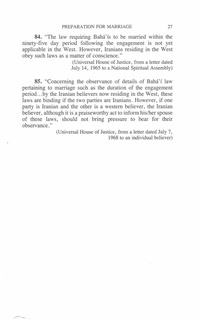 84. “The law requiring Bahá’ís to be married within the ninety-five day period following the engagement is not yet applicable in the West. However, Iranians residing in the West obey such laws as a matter of conscience.”
July 14, 1965 to a National Spiritual Assembly)
85. “Concerning the observance of details of Bahá’í law pertaining to marriage such as the duration of the engagement period...by the Iranian believers now residing in the West, these laws are binding if the two parties are Iranians. However, if one party is Iranian and the other is a western believer, the Iranian believer, although it is a praiseworthy act to inform his/her spouse of these laws, should not bring pressure to bear for their observance.”
1968 to an individual believer)