
The Significance of Bahá’u’lláh’s Revelation/Response to His Call

Response to His Call
[edit]Introduction
[edit]The recognition of Bahá’u’lláh in this Day is the very purpose of our creation. "The ear of man hath been created that it may hearken unto the Divine Voice on this Day that hath been mentioned in all the Books, Scriptures, and Tablets."
With the appearance of first the Báb and then Bahá’u’lláh, all the signs announced in the Books were revealed and made clear. The Call of God was raised and the whole of mankind summoned to attain the Divine Presence. So clear and manifest are the signs and so loud the call that no one has any excuse for not responding.²
To recognize Bahá’u’lláh is to recognize God. "Attainment unto the Divine Presence can be realized solely by attaining His Presence."³
Yet, although the first duty of every soul is to recognize God's Manifestation, each soul has the freedom to reject or accept the Call of the Beloved. The choice of each person has a direct impact on the forces released by His Revelation that are, as described in the last chapter, driving the destiny of humanity. The response to the Call of Bahá’u’lláh and the consequences of that response is the subject of this chapter.
1 Bahá’u’lláh, Epistle to the Son of the Wolf 2
2 Bahá’u’lláh, in The Promised Day is Come 6
3 Tablets of Bahá’u’lláh 50
[Page 50]
Overview
[edit]"The shout hath been raised," Bahá’u’lláh states, "and the people have come forth from their graves, and arising, are gazing around them. Some have made haste to attain the court of the God of Mercy, others have fallen down on their faces in the fire of Hell, while still others are lost in bewilderment."4
These three categories of humanity's response to Bahá’u’lláh's Call-acceptance, opposition, and heedlessness-each have specific consequences for the individual and society. God responds in turn to humanity's response.
- Those who accept become the recipients of divine grace and instruments for achieving the purpose of God for this Day.
- Those who oppose Bahá’u’lláh are, ultimately, frustrated in their purpose. Instead of slowing the Faith their attacks draw a measure of divine power that accelerates its progress.
- Those who are heedless are like a plant which turns away from the sun-they have cut themselves off from the blessings of the new Revelation. Heedlessness prolongs and aggravates the suffering of humanity which cannot be relieved without applying the remedy prescribed by the Divine Physician, Bahá’u’lláh.
Explanation
[edit]Although the Call of Bahá’u’lláh was made to all humanity, it was the world's rulers and religious leaders who initially received the full force of His Message. At that time in history, the majority of the masses of people were under the influence of civil and religious authorities, and had little opportunity to fairly judge or to embrace the truth of the claim of the Message offered to them.³
When the kings and religious leaders refused to heed the Divine summons or arose in opposition to it, the "Divine chastisement" promised by Bahá’u’lláh came to pass. Their Kingdoms fell, and their power was seized by God and placed, instead, in the hands of the people. The people, unfortunately, were also slow to respond.
[Page 51] Because of the heedlessness and opposition of the leaders and their peoples, world affairs have been thrown into chaos. This is a condition we still suffer from, and will continue to suffer from, until the counsels of Bahá’u’lláh for regenerating the world are obeyed. "This judgement of God," Shoghi Effendi states, "... is both a retributory calamity and an act of supreme discipline." Humanity is "being simultaneously called upon to give account for its past actions, and is being purged and prepared for its future mission."8
An example of the implications of acceptance and opposition to the call of Bahá’u’lláh can be found in an event related to the delivery of the one of the Tablets of Bahá’u’lláh to the kings.
Bádí’ was the son of an early believer, but ignored Bahá’u’lláh’s Call. He was disobedient, and a great concern to his family. After meeting Bahá’u’lláh, however, Bádí’ was transformed. He became a new creation—filled with radiant joy. To be of service to his Lord, Bádí’ eagerly carried the Tablet of Bahá’u’lláh to the Shah of Iran. Such an act, however, was certain to lead to his death. As he delivered the Message he was seized, tortured, and, eventually, his head was crushed. Yet Bádí’ received a measure of divine assistance that enabled him to endure his trials and accomplish his purpose. Despite his afflictions Bádí’ remained content and steadfast until the end. His behavior astonished those responsible for his sufferings. Bádí’ was only one of thousands transformed by Bahá’u’lláh’s teachings who arose to serve humanity.
The recipient of the Tablet, Náşiri’d-Dín Sháh, the ruler of Iran, was a determined enemy of Bahá’u’lláh. He was responsible for the martyrdom of the Báb, the imprisonment and exiles of Bahá’u’lláh, and the relentless persecution of the believers. He exerted every effort within his vast earthly powers to extinguish the new Faith. His efforts proved fruitless. "Wert thou to incline thine ear unto the shrill Pen of Glory," Bahá’u’lláh wrote to him, "... thou wouldst ... regard thy sovereignty as the most contemptible of thy possessions, abandoning it to whosoever might desire it, and setting thy face toward the Horizon aglow with the light of His countenance."10
The Shah ignored Bahá’u’lláh’s summons. His efforts to destroy the Faith, however, only resulted in its expansion and greater glory.
8 Shoghi Effendi, The Promised Day is Come 4
9 To read about the story of Bádí’ see The Revelation of Bahá’u’lláh, Vol. III, pages 172-203.
10 The Proclamation of Bahá’u’lláh 58
[Page 52]
Readings
[edit]1. "Hear Me, ye mortal birds! In the Rose Garden of changeless splendor a Flower hath begun to bloom, compared to which every other flower is but a thorn, and before the brightness of Whose glory the very essence of beauty must pale and wither. Arise, therefore, and, with the whole enthusiasm of your hearts, with all the eagerness of your souls, the full fervor of your will, and the concentrated efforts of your entire being, strive to attain the paradise of His presence, and endeavor to inhale the fragrance of the incorruptible Flower, to breathe the sweet savors of holiness, and to obtain a portion of this perfume of celestial glory. Whoso followeth this counsel will break his chains asunder, will taste the abandonment of enraptured love, will attain unto his heart's desire, and will surrender his soul into the hands of His Beloved....
"Night hath succeeded day, and day hath succeeded night, and the hours and moments of your lives have come and gone, and yet none of you hath, for one instant, consented to detach himself from that which perisheth. Bestir yourselves, that the brief moments that are still yours may not be dissipated and lost. Even as the swiftness of lightning your days shall pass, and your bodies shall be laid to rest beneath a canopy of dust. What can ye then achieve? How can ye atone for your past failure?
"The everlasting Candle shineth in its naked glory. Behold how it hath consumed every mortal veil. O ye moth-like lovers of His light! Brave every danger, and consecrate your souls to its consuming flame.... With a zest that none can equal make haste to attain unto Him. The Flower, thus far hidden from the sight of men, is unveiled to your eyes. In the open radiance of His glory He standeth before you. His voice summoneth all the holy and sanctified beings to come and be united with Him." —Bahá’u’lláh, Gleanings 320-22
2. "In a hundred volumes... the Bearer of such a Message has proclaimed, as no Prophet before Him has done, the Mission with which God has entrusted Him. To emperors, kings, princes and potentates, to rulers, governments, clergy and peoples, whether of the East or of the West, whether Christian, Jew, Muslim, or Zoroastrian, He addressed, for well-nigh fifty years, and in the most tragic circumstances, these priceless pearls of knowledge and wisdom.... Forsaking fame and fortune, accepting imprisonment and exile, careless of ostracism and obloquy, submitting to physical indignities and cruel deprivations, He, the Vicegerent of God on earth, suffered Himself to be banished from place to place and from country to country...." —Shoghi Effendi, The Promised Day is Come 6
Vocabulary
[edit]incorruptible: incapable of being destroyed
celestial: heavenly, divine
abandonment: carefree disregard for consequences
enraptured: filled with joy
dissipated: wasted
canopy: overhanging cover
atone: make amends for a wrong
zest: keen enjoyment
potentates: powerful rulers
ostracism: barred from favor; exiled from one's native land
obloquy: widespread reproach; disgrace resulting from public censure
vicegerent: administrative deputy of a king or judge
[Page 53]
Acceptance: The Station of the Believers
[edit]3. "Behold, how the divers peoples and kindreds of the earth have been waiting for the coming of the Promised One. No sooner had He, Who is the Sun of Truth, been made manifest, than, lo, all turned away from Him, except then whom God was pleased to guide. We dare not, in this Day, lift the veil that concealeth the exalted station which every true believer can attain, for the joy which such a revelation must provoke might well cause a few to faint away and die....
"From the excellence of so great a Revelation the honor with which its faithful followers must needs be invested can be well imagined. By the righteousness of the one true God! The very breath of these souls is itself richer than all the treasures of the earth." --Bahá’u’lláh, Gleanings 9-10
4. "These few have been endued with the Divine Elixir that can, alone, transmute into purest gold the dross of the world, and have been empowered to administer the infallible remedy for all the ills that afflict the children of men." -Bahá’u’lláh, Gleanings 183
5. "The Word of God hath set the heart of the world afire; how regrettable if ye fail to be enkindled with its flame! ... Knit your souls together, and resolve to adorn yourselves with the ornament of a goodly and praiseworthy character. Let your principal concern be to rescue the fallen from the slough of impending extinction, and to help him embrace the ancient Faith of God. Your behavior towards your neighbor should be such as to manifest clearly the signs of the one true God, for ye are the first among men to be re-created by His Spirit, the first to adore and bow the knee before Him, the first to circle round His throne of glory. I swear by Him Who hath caused Me to reveal whatever hath pleased Him! Ye are better known to the inmates of the Kingdom on high than ye are known to your own selves. Think ye these words to be vain and empty? Would that ye had the power to perceive the things your Lord, the All-Merciful, doth see-things that attest the excellence of your rank, that bear witness to the greatness of your worth, that proclaim the sublimity of your station! God grant that your desires and unmortified passions may not hinder you from that which hath been ordained for you." -Bahá’u’lláh, Gleanings 316-17
6. "... How superior must be the destiny of the true believer, whose existence and life are to be regarded as the originating purpose of all creation.... His spirit will everlastingly circle round the Will of God. He will last as long as God, Himself, will last."-Bahá’u’lláh, Gleanings 141
elixir: a substance believed to prolong life indefinitely and to change metals into gold
transmute: to change from one form, substance, nature, or class to another
dross: any worthless matter
slough: situation from which it is difficult to get out; place full of deep mud, bog
sublimity: magnificence
unmortified: unrestrained; not subdued
[Page 54]
Opposition: From Leaders and Peoples of the World
[edit]7. "At no time, in no Dispensation, have the Prophets of God escaped the blasphemy of their enemies, the cruelty of their oppressors, the denunciation of the learned of their age, who appeared in the guise of uprightness and piety." —Bahá’u’lláh, Gleanings 57-58
8. "For the trials which have afflicted the Faith of Bahá’u’lláh a responsibility appalling and inescapable rests upon those into whose hands the reins of civil and ecclesiastical authority were delivered. "... Small wonder that He Who is the King of kings and Vice-gerent of God Himself should, when abandoned, condemned and persecuted, have uttered this epigrammatic and momentous prophecy: 'From two ranks amongst men power hath been seized: kings and ecclesiastics.'" —Shoghi Effendi, The Promised Day is Come 18-20
9. "... The history of the first hundred years of its evolution resolves itself into a series of internal and external crises, of varying severity, devastating in their immediate effects, but each mysteriously releasing a corresponding measure of divine power, lending thereby a fresh impulse to its unfoldment. ..." —Shoghi Effendi, God Passes By xiii
10. "How great, how very great is the Cause! How very fierce the onslaught of all the peoples and kindreds of the earth. Ere long shall the clamor of the multitude throughout Africa, throughout America, the cry of the European and of the Turk, the groaning of India and China, be heard from far and near. One and all, they shall arise with all their power to resist His Cause. Then shall the knights of the Lord, assisted by His grace from on high make manifest the truth of the verse: 'Behold the confusion that hath befallen the tribes of the defeated!'" —‘Abdu’l-Bahá, in The World Order of Bahá’u’lláh 17
...
11. "May God confirm the day when a score of ministers of the churches may arise and... cry at the top of their voices that the Bahá’ís are misguided. I would like to see that day, for that is the time that the Cause of God will spread."—‘Abdu’l-Bahá, Crisis and Victory 6
12. "The people of the world have grievously erred, for they fondly imagine that they can exterminate the Cause of God.... I swear by the righteousness of God that the more they endeavor to quench His Light, the brighter will it shine, and the more they strive to smother its flame, the fiercer will it burn. God's invincible Will far transcendeth their devices, and His Purpose is supreme above all human desires.... Every created thing is impotent before the evidences of His invincible might...." —Bahá’u’lláh, The Bahá’í World, Vol. XVIII, 13
blasphemy: irreverence toward God or anything sacred
denunciation: severe criticism
guise: external appearance
piety: devotion to religion
appalling: filled with horror or dismay
ecclesiastical: relating to a church
epigrammatic: brief, pointed and rich in meaning
kindreds: groups of persons of or regarded as of common ancestry
clamor: a state of noisy confusion
exterminate: to destroy utterly
[Page 55]
Heedlessness: The Retributive and Creative Process
[edit]13. "The Bugle hath sounded, the Trumpet hath been blown, the Crier hath raised his call, and all upon the earth have swooned away --but still do the dead, in the tombs of their bodies, sleep on." --Selections from the Writings of ‘Abdu’l-Bahá 13
14. "He is indeed as one dead who, at the wondrous dawn of this Revelation, hath failed to be quickened by its soul-stirring breeze. He is indeed a captive who hath not recognized the Supreme Redeemer, but hath suffered his soul to be bound, distressed and helpless, in the fetters of his desires.
"O My servants! Whoso hath tasted of this Fountain hath attained unto everlasting Life, and whoso hath refused to drink therefrom is even as the dead." -Bahá’u’lláh, Gleanings 169
15. "Witness how the world is being afflicted with a fresh calamity every day. Its tribulation is continually deepening.... At one time it hath been agitated by contentions and disputes, at another it hath been convulsed by wars, and fallen a victim to inveterate diseases. Its sickness is approaching the stage of utter hopelessness, inasmuch as the true Physician is debarred from administering the remedy, whilst unskilled practitioners are regarded with favor, and are accorded full freedom to act." -Bahá’u’lláh, Gleanings 39-40
16. "Brimful and bitter indeed is the cup of humanity that has failed to respond to the summons of God....
"... The flames which His Divine justice have kindled cleanse an unregenerate humanity, and fuse its discordant, its warring elements as no other agency can cleanse or fuse them. It is not only a retributory and destructive fire, but a disciplinary and creative process, whose aim is the salvation, through unification, of the entire planet." -Shoghi Effendi, The Promised Day is Come 115-16
17. "The world is, in truth, moving on toward its destiny. ... The Revelation of Bahá’u’lláh has ... 'lent a fresh impulse and set a new direction' to this vast process now operating in the world. The fires lit by this great ordeal are the consequences of men's failure to recognize it. They, are, moreover, hastening its consummation. Adversity, prolonged, world-wide, afflictive, allied to chaos and universal destruction, must needs convulse the nations, stir the conscience of the world, disillusion the masses, precipitate a radical change in the very conception of society, and coalesce ultimately the disjointed, the bleeding limbs of mankind into one body, single, organically united, and indivisible." -Shoghi Effendi, The Promised Day is Come 122-23
swoon: to faint
fetters: bonds, chains
afflicted: suffering pain and distress
calamity: disaster
inveterate: deeply rooted; long-standing
debarred: held back
practitioners: those who practice a profession
unregenerate: unrepentant or unwilling to reform
fuse: unite
discordant: not in agreement with one another
retributory: punishing as a recompense or repayment for some action
convulse: to cause to move violently
disillusion: to leave without illusion; make disenchanted
precipitate: cause to happen quickly
coalesce: grow together
disjointed: separated
[Page 56]
Illustrations
[edit]The following story was the experience of a new believer, told by a Bahá’í pioneer to Africa:
"He had been a teacher at a church school when he had first heard of the Faith. One of the Bahá’ís gave him a pamphlet to read. He took it back to his room at the school. It was discovered by the school authorities, and he was told to destroy it and have nothing to do with this new belief. He refused saying, 'This is my faith. This I can really believe.' He was warned that if he persisted, he would lose his job. He must either give up his job or this foolishness.
"Foolishness?" he asked. 'That there is only one God and only one religion? That all the Messengers of God are equal and teach the same truth in different ages? That all men are brothers, and that mankind must not only believe this is so, but behave that way? This is foolishness?'
"He was told to make a choice.
"There is no choice,' he told them. 'Nothing can make me give up my faith.'
"We shall see,' he was told.
"He was put out of his job. He was barred from securing teaching work at any other school. His father and the tribal authorities were approached by the clergy and asked to influence the boy to return to his work and to the church. He was threatened with banishment from the tribe, with disinheritance, with open opposition....
"Everyone opposed him. Obstacles were hurled into his path.... As a last resort, they tried to get the young man's wife to sway him, to threaten him with divorce unless he abandoned the Bahá’í Faith.
"Little by little, he had been shorn of every tie. He had given up his job, his tribe, his family, his friends, and now his wife and children. There was, he said, no praise due him. If there had been a choice to make, perhaps his wisdom could have been commended; but since God had talked to his heart, the world had died before his eyes....
"Later when we arrived in Dar es Salaam, we heard that this young man had already brought eight new people into the Faith at his pioneer post."
-Sears, 'Black Sunlight,' The Bahá’í World, Vol. XII, 929-30
[Page 57]
The Prisoner and the Kings
[edit]"On June 18, 1871, Emperor Kaiser William I of Germany entered Berlin at the head of his victorious troops. It was a day of great rejoicing. The France of Napoleon III had been crushed. The Emperor was a national hero in Germany. He was becoming legendary. As the clattering hoofbeats of victory rang through the streets of Berlin, Kaiser William I was the cynosure of all eyes.
"He had achieved almost every dream. He had become, in turn, prince, king, and now emperor, of a united Germany. There was no one to challenge him.
"And then, one voice was raised in warning. From His far-off prison cell, Bahá’u’lláh reminded the Kaiser of what had befallen the Emperor of France. He warned William that exactly the same fate awaited him, if he did not follow the Counsels which God was offering to the kings of the earth, and devote himself to the service of unity and justice....
"William I did not listen to the warning from the Prisoner of ‘Akká. His death delivered Germany into the hands of his reckless and arrogant grandson, the young William II. The new Kaiser embarked on a cause that was directly opposed to almost every Counsel of the Prisoner. . . .
"The Prisoner had written: 'O banks of the Rhine! We have seen you covered with gore, inasmuch as the swords of retribution were drawn against you, and you shall have another turn. . . .'
"Because of an aggressive military policy, Germany suffered not once, but twice. She was crushed in both World Wars....
"On November 11, 1918, newspaper headlines in Berlin flashed the news: 'Kaiser abdicates!'
"The dumbfounded and war-weary Emperor had not yet even been informed. On Sunday, November 10, one day before the Armistice, William II had fled ignominiously to Holland....
"[An historian wrote:] 'There have been more tragic and more disgraceful exits from the stage of history, but few more inglorious."
"... The empire of the Hohenzollerns toppled to the dust. Its official death-knell was sounded November 28, 1918 when William II signed a formal act of abdication which ended his rule both as a Prussian King and German Emperor. . . .
"Around the world, clergymen saw in these cataclysmic events the fulfillment of Biblical prophecies. But the truth is far greater than any of them grasped. The prophet Jeremiah, speaking of the latter days, said that God promised 'And I will set my throne in Elam (Persia), and I will destroy from thence the king and the princes...."
-Sears, The Prisoner and the Kings 46-64
Vocabulary
[edit]cynosure: center of attraction
gore: the fluid that circulates in the heart, arteries, capillaries, and veins of a vertebrate animal
abdicates: parts formally or definitely with a position of honor or power
ignominiously: shamefully, in disgrace
[Page 58]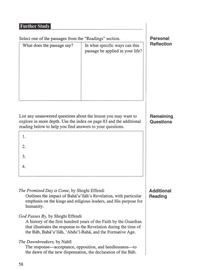
Further Study
[edit]Select one of the passages from the "Readings" section.
What does the passage say?
In what specific ways can this passage be applied in your life?
Personal Reflection
[edit]List any unanswered questions about the lesson you may want to explore in more depth. Use the index on page 83 and the additional reading below to help you find answers to your questions.
Remaining Questions
[edit]1. 2. 3. 4.
Additional Reading
[edit]The Promised Day is Come, by Shoghi Effendi Outlines the impact of Bahá’u’lláh's Revelation, with particular emphasis on the kings and religious leaders, and His purpose for humanity.
God Passes By, by Shoghi Effendi A history of the first hundred years of the Faith by the Guardian that illustrates the response to the Revelation during the time of the Báb, Bahá’u’lláh, ‘Abdu’l-Bahá, and the Formative Age.
The Dawnbreakers, by Nabíl
The response-acceptance, opposition, and heedlessness-to the dawn of the new dispensation, the declaration of the Báb.
[Page 59]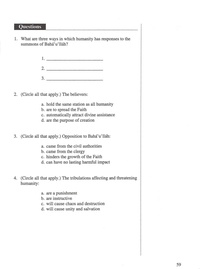
Questions
[edit]1. What are three ways in which humanity has responses to the summons of Bahá’u’lláh? 1. 2. 3.
2. (Circle all that apply.) The believers: a. hold the same station as all humanity b. are to spread the Faith c. automatically attract divine assistance d. are the purpose of creation
3. (Circle all that apply.) Opposition to Bahá’u’lláh: a. came from the civil authorities b. came from the clergy c. hinders the growth of the Faith d. can have no lasting harmful impact
4. (Circle all that apply.) The tribulations affecting and threatening humanity:
a. are a punishment
b. are instructive
c. will cause chaos and destruction
d. will cause unity and salvation
[Page 60]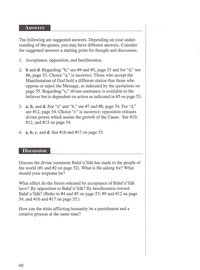
Answers
[edit]The following are suggested answers. Depending on your understanding of the quotes, you may have different answers. Consider the suggested answers a starting point for thought and discussion.
1. Acceptance, opposition, and heedlessness.
2. b and d. Regarding "b," see #4 and #5, page 53 and for "d," see #6, page 53. Choice "a," is incorrect. Those who accept the Manifestation of God hold a different station that those who oppose or reject the Message, as indicated by the quotations on page 55. Regarding "c," divine assistance is available to the believer but is dependent on action as indicated in #5 on page 53.
3. a, b, and d. For "a" and "b," see #7 and #8, page 54. For "d," see #12, page 54. Choice "c" is incorrect; opposition releases divine power which assists the growth of the Cause. See #10, #12, and #13 on page 54.
4. a, b, c, and d. See #16 and #17 on page 55.
Discussion
[edit]Discuss the divine summons Bahá’u’lláh has made to the people of the world (#1 and #2 on page 52). What is He asking for? What should your response be?
What effect do the forces released by acceptance of Bahá’u’lláh have? By opposition to Bahá’u’lláh? By heedlessness toward Bahá’u’lláh? (Refer to #4 and #5 on page 53; #9 and #12 on page 54; and #16 and #17 on page 55.)
How can the trials afflicting humanity be a punishment and a creative process at the same time?
[Page 61]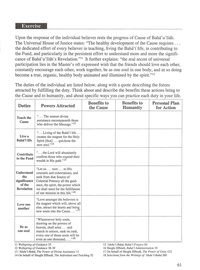
Exercise
[edit]Upon the response of the individual believer rests the progress of Cause of Bahá’u’lláh. The Universal House of Justice states: "The healthy development of the Cause requires... the dedicated effort of every believer in teaching, living the Bahá’í life, in contributing to the Fund, and particularly in the persistent effort to understand more and more the significance of Bahá’u’lláh's Revelation." It further explains: "the real secret of universal participation lies in the Master's oft expressed wish that the friends should love each other, constantly encourage each other, work together, be as one soul in one body, and in so doing become a true, organic, healthy body animated and illumined by the spirit."¹²
The duties of the individual are listed below, along with a quote describing the forces attracted by fulfilling the duty. Think about and describe the benefits these actions bring to the Cause and to humanity, and about specific ways you can practice each duty in your life.
| Duties | Powers Attracted | Benefits to the Cause | Benefits to Humanity | Personal Plan for Action |
|---|---|---|---|---|
| Teach the Cause | "...The unseen divine assistance encompasseth those who deliver the Message."¹³ | |||
| Live a Bahá’í life | "... Living of the Bahá’í life.... creates the magnet for the Holy Spirit [that]... quickens the new soul."¹⁴ | |||
| Contribute to the Fund | "... the Lord will abundantly confirm those who expend their wealth in His path."¹⁵ | |||
| Understand the significance of the Revelation | "Let us... turn... to His counsels and exhortations, and seek from that Source of Celestial Potency all the guidance, the spirit, the power which we shall need for the fulfillment of our mission in this life."¹⁶ | |||
| Love one another | "Love amongst the believers is the magnet which will, above all else, attract the hearts and bring new souls into the Cause...."¹⁷ | |||
| Be as one soul | "Whensoever holy souls, drawing on the powers of heaven, shall arise... and march in unison, rank on rank, every one of those souls will be even as one thousand...."¹⁸ |
¹¹ Wellspring of Guidance 25
¹² Wellspring of Guidance 38-39
¹³ ‘Abdu’l-Bahá, The Power of Divine Assistance 11
¹⁴ On behalf of Shoghi Effendi, The Individual and Teaching 32
¹⁵ ‘Abdu’l-Bahá, Bahá’í Prayers 84
¹⁶ Shoghi Effendi, Bahá’í Administration 35
¹⁷ On behalf of Shoghi Effendi, The Power of Unity 123
¹⁸ Selections from the Writings of ‘Abdu’l-Bahá 260
[Page 62]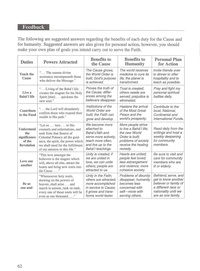
Feedback
[edit]The following are suggested answers regarding the benefits of each duty for the Cause and for humanity. Suggested answers are also given for personal action, however, you should make your own plan of goals you intend carry out to serve the Faith.
| Duties | Powers Attracted | Benefits to the Cause | Benefits to Humanity | Personal Plan for Action |
|---|---|---|---|---|
| Teach the Cause | "The unseen divine assistance encompasseth those who deliver the Message." | The Cause grows; the World Order is built; God's purpose is achieved. | The world receives medicine to cure its ills; the planet is transformed. | Invite friends over to dinner to offer hospitality and to teach as possible. |
| Live a Bahá’í life | "... Living of the Bahá’í life... creates the magnet for the Holy Spirit [that]... quickens the new soul." | Proves the truth of the Cause; differences among the believers disappear. | Trust is created; others needs are served; prejudice is eliminated. | Pray and fight my personal spiritual battles daily. |
| Contribute | "... the Lord will abundantly confirm those who expend their wealth in His path." | Institutions of the World Order are built; the Faith can grow and develop. | Hastens the arrival of the Most Great Peace and the world's prosperity. | Contribute to the local, National, Continental and International Funds. |
| Understand the significance of the Revelation | "Let us... turn... to His counsels and exhortations, and seek from that Source of Celestial Potency all the guidance, the spirit, the power which we shall need for the fulfillment of our mission in this life." | We become more attached to Bahá’u’lláh and serve more actively, teach more often, and live up to the Bahá’í teachings. | More people strive to live a Bahá’í life; the new World Order is built; problems of society receive the healing remedy. | Read daily from the writings and host a weekly deepening for community members. |
| Love one another | "This love amongst the believers is the magnet which will, above all else, attract the hearts and bring new souls into the Cause...." | Unity is created; if we are united in love, we can unite others; people are attracted to us. | Hearts are united; people feel loved; less estrangement and violence; more cohesive society. | Be sure to visit and care for community members who are ill or elderly. |
| Be as one soul | "Whensoever holy souls, drawing on the powers of heaven, shall arise... and march in unison, rank on rank, every one of those souls will be even as one thousand...." | Unity in the Faith; others are attracted; more accomplished in service to Cause; it grows and transforms world faster. | Problems of disunity disappear; humanity becomes less concerned with self—more with serving others. | Befriend, serve, and get to know another believer or family of a different race or nationality until we are as one family. |