
The Significance of Bahá’u’lláh’s Revelation/The Station of Bahá’u’lláh

2 The Station of Bahá’u’lláh
[edit]Introduction
[edit]The last chapter gave us a glimmering of the greatness of the Day of God. In this chapter we will try to get some insight into the station of the One Who ushered in this great Day.¹
Who is Bahá’u’lláh? To know the answer to this question, we must see Him, not through our own preconceptions, but as He presents Himself. “Look . . . upon Me,” Bahá’u’lláh states “with Mine eyes, and not with the eyes of anyone besides Me. Ye will, otherwise, be never capable of recognizing Me, though ye ponder My Cause as long as My Kingdom endureth, and meditate upon all created things throughout the eternity of God. . . .”²
1 Because of the topic, this chapter is much longer than any of the others. There are six pages of Readings. If you are involved in group study or in study at a Bahá’í school you may wish to cover this chapter in two sessions.
2 Gleanings 272-73
[Page 16]
Overview
[edit]“O ye that inhabit the heavens and the earth!” Bahá’u’lláh proclaims. “There hath appeared what hath never previously appeared. He Who, from everlasting, had concealed His Face from the sight of creation is now come.”3
In presenting Himself to humanity, Bahá’u’lláh has made an extraordinary claim—a claim that challenges everyone to investigate and accept its truth. He alone, of all God’s Manifestations, has claimed to usher in the long-promised Day of God. To gain some insight into the station of Bahá’u’lláh, we need to understand the claim of:
- His relation to humanity;
- His relation to other Manifestations; and
- His relation to God.
Explanation
[edit]His Relation to Humanity
[edit]Bahá’u’lláh is the Promised One. “All the divers kindred of the earth” have “yearned” for His coming.4 He is the “Best-Beloved” Who is seeking “reunion” with His loved ones.5 He claims for Himself the heart of every person, that He may transform them from material to spiritual beings. “We, verily, have come for your sakes, and have borne the misfortunes of the world for your salvation.”6
Bahá’u’lláh is the intermediary between God and humanity in this Day. He has come to judge humanity and to set its affairs in order. He has revealed the laws of God. He has laid the foundation for a new World Order. He has provided teachings necessary to achieve “that Age of Ages when swords will be beaten into plowshares, when the Kingdom promised by Jesus Christ will have been established, and the peace of the planet definitely and permanently ensured.”7
3 Gleanings 31
4 Bahá’u’lláh, in The Advent of Divine Justice 78
5 Bahá’u’lláh, Gleanings 32-34
6 The Proclamation of Bahá’u’lláh 92
7 Shoghi Effendi, The Promised Day is Come, Preface, v
[Page 17]
His Relation to Other Manifestations
[edit]Bahá’u’lláh explains that the essential reality of all the Manifestations is the same.8 They do differ, however, in the nature of their assigned mission and in the extent of the Revelation They bring.9
The Manifestations of the past prepared humanity for the coming of Bahá’u’lláh. “Every Prophet hath announced the coming of this Day,” Bahá’u’lláh states, “and every Messenger hath groaned in His yearning for this Revelation. . . ”10 The Manifestations of the future will provide additional guidance from God, but will, nevertheless, remain under the shadow of Bahá’u’lláh. The unique position Bahá’u’lláh holds in relation to the other Manifestations is due to the unprecedented measure of the Revelation of the light of God He brings and the pivotal nature of His mission in the development of human affairs.
His Relation to God
[edit]God is exalted above all creation. He is far above even the ability of the Manifestations of God to understand Him.11
The Manifestations are like perfect mirrors that reflect the image of the sun (God).12 If we were to look in the mirror and say “that is the sun” it would be a true statement. Similarly, if we say “that is not the sun” it would also be true. “Were any of the all-embracing Manifestations of God to declare: ‘I am God,’” Bahá’u’lláh states, “He, verily speaketh the truth. . . . And were they to say, ‘We are the Servants of God,’ this also is a manifest and indisputable fact.”13
Bahá’u’lláh reflects the image of God to a measure unsurpassed in bygone dispensations. Even the name “Day of God” testifies to the degree to which God has revealed Himself. It is even as if meeting God face-to-face. The Báb states that any mention of the presence of God in all the Holy Scriptures is a reference to the presence of “Him Whom God shall make manifest” [Bahá’u’lláh].14
8 Gleanings 51
9 Bahá’u’lláh, Gleanings 52
10 In The Advent of Divine Justice 78
11 Bahá’u’lláh, Gleanings 62-63
12 Bahá’u’lláh, Gleanings 48
13 Bahá’u’lláh, Gleanings 54
14 Taherzadeh, The Revelation of Bahá’u’lláh, Vol. II, 17
[Page 18]
Readings
[edit]|
1. “Verily I say, this is the Day in which mankind can behold the Face, and hear the Voice, of the Promised One. The Call of God hath been raised, and the light of His countenance hath been lifted up upon men. It behoveth every man to blot out the trace of every idle word from the tablet of his heart, and to gaze, with an open and unbiased mind, on the signs of His Revelation, the proofs of His Mission, and the tokens of His glory.” —Bahá’u’lláh, Gleanings 10-11 2. “I am the One Whom the tongue of Isaiah hath extolled, the One with Whose name both the Torah and the Evangel were adorned. . . .” —The Proclamation of Bahá’u’lláh 29 3. “To Israel He was neither more nor less than the incarnation of the ‘Everlasting Father,’ the ‘Lord of Hosts’ come down ‘with ten thousand saints’; to Christendom Christ returned ‘in the glory of the Father,’ to Shí‘ah Islám the return of the Imám Husayn; to Sunní Islám the descent of the ‘Spirit of God’ (Jesus Christ); to the Zoroastrians the promised Sháh-Bahrám; to the Hindus the reincarnation of Krishna; to the Buddhists the fifth Buddha.” “To Him Isaiah, the greatest of the Jewish prophets, had alluded as the ‘Glory of the Lord,’ the ‘Everlasting Father,’ the ‘Prince of Peace,’ the ‘Wonderful,’ the ‘Counsellor,’ the ‘Rod come forth out of the stem of Jesse’ and the ‘Branch grown out of His roots,’ . . . Who ‘shall judge among the nations,’ Who ‘shall smite the earth with the rod of His mouth, and with the breath of His lips slay the wicked,’ and Who ‘shall assemble the outcasts of Israel, and gather together the dispersed of Judah from the four corners of the earth. . . . “To Him Jesus Christ had referred as the ‘Prince of this world,’ as the ‘Comforter’ Who will ‘reprove the world of sin, and of righteousness, and of judgement,’ as the ‘Spirit of Truth’ Who ‘will guide you unto all truth’ Who ‘shall not speak of Himself, but whatsoever He shall hear, that shall He speak,’ as the ‘Lord of the Vineyard,’ and as the ‘Son of Man’ Who ‘shall come in the glory of His Father’ ‘in the clouds of heaven with power and great glory,’ with ‘all the holy angels’ about Him, and ‘all nations’ gathered before His throne.” —Shoghi Effendi, God Passes By 94-95 4. “We, verily, have come for your sakes, and have borne the misfortunes of the world for your salvation. Flee ye the One Who hath sacrificed His life that ye may be quickened? . . . Say: We, in truth, have opened unto you the gates of the Kingdom. Will ye bar the doors of your houses in My face?” —Tablets of Bahá’u’lláh 10-11 |
His Relation to Humanity countenance: face anguish: extreme pain or distress of mind Torah: the Pentateuch, or first five books of the Old Testament; the entire body of Jewish law Evangel: the Gospel incarnation: embodiment in human form and substance Everlasting Father: Isa 9:6 Ten thousand saints: Deu 33:2 Lord of Hosts: there are over 250 references to the Lord of Hosts in the old testament glory of the Father: Mat 16:27; Mar 8:38 alluded: called or directed attention to something Isa 9:6, Isa 2:4, Isa 11:12 Prince of this world: Joh 14:30 Comforter: Joh 14:16; Joh 15:26; Joh 16:7-8 reprove: express disapproval to or of Spirit of Truth: Joh 16:13 |
[Page 19] 5. "Say: He Who is the Unconditioned is come, in the clouds of light, that He may quicken all created things with the breezes of His Name, the Most-Merciful, and unify the world, and gather all men around this table which hath been sent down from heaven."
-Bahá’u’lláh, Epistle to the Son of the Wolf 46
5. "Say: He Who is the Unconditioned is come, in the clouds of light, that He may quicken all created things with the breezes of His Name, the Most-Merciful, and unify the world, and gather all men around this table which hath been sent down from heaven."
-Bahá’u’lláh, Epistle to the Son of the Wolf 46
6. "Praise be to Him Who hath fashioned this new era, this age of majesty, even as the unfolding pageant where the realities of all things can be exposed to view.... Both the seen and the unseen worlds have been illumined, and the Promised One hath come to earth and the beauty of the Adored One hath shone forth.
"Salutations, blessings, and welcome to that Universal Reality, that Perfect Word, that Manifest Book, that Splendor which hath dawned in the highest heaven, that Guide of all nations, that Light of the world—the billowing ocean of Whose abounding grace hath flooded all creation, in such wise that the waves thereof have cast upon the sands of this visible world their shining pearls. Now hath the Truth appeared, and falsehood fled away; now hath the day dawned and jubilation taken over, wherefore men's souls are sanctified, their spirits purged, their hearts rejoiced their minds purified, their secret thoughts made wholesome, their consciences washed clean, their inmost selves made holy: for the Day of Resurrection hath come to pass, and the bestowals of thy Lord, the Forgiving, have encompassed all things." -Selections from the Writings of ‘Abdu’l-Bahá 38-39
7. "Verily, He (Jesus) said: 'Come ye after Me, and I will make you to become fishers of men.' In this day, however, We say: 'Come ye after Me, that We may make you to become quickeners of mankind.' -The Proclamation of Bahá’u’lláh 91
8. "He Who in such dramatic circumstances was made to sustain the overpowering weight of so glorious a Mission was none other than the One Whom posterity will acclaim, and Whom innumerable followers already recognize, as the Judge, the lawgiver and Redeemer of all mankind, as the Organizer of the entire planet, as the Unifier of the children of men, as the Inaugurator of the long-awaited millennium, as the Originator of a new 'Universal Cycle,' as the Establisher of the Most Great Peace, as the Fountain of the Most Great Justice, as the Proclaimer of the coming of age of the entire human race, as the Creator of a new World Order, as the Inspirer and Founder of a world civilization." --Shoghi Effendi, God Passes By 93-94
Glossary
[edit]Unconditioned: not limited by conditions of time or space; absolute
quicken: give life to
pageant: a play or dramatic spectacle devised for a public celebration
salutations: a formal expression of praise; the ceremonial words or acts of one who meets, welcomes, or formally addresses another
jubilation: the state of being exultant or rejoicing in triumph
posterity: succeeding generations
acclaim: declare
inaugurator: one who formally opens something such as an era or public institution
millennium: period of 1000 years; the thousand years that Christ will reign on earth (Rev 20:1-6)
[Page 20]
His Relation to Other Manifestations
[edit]9. “O people! I swear by the one true God! This is the Ocean out of which all Seas have proceeded, and with which every one of them will ultimately be united. From Him all the Suns have been generated, and unto Him they will all return. Through His potency the Trees of Divine Revelation have yielded their fruits, every one of which hath been sent down in the form of a Prophet, bearing a Message to God’s creatures. . . . This He hath accomplished through the agency of but one Letter of His Word, revealed by His Pen—a Pen moved by His directing Finger—His Finger itself sustained by the power of God’s Truth.” —Bahá’u’lláh, in The Advent of Divine Justice 80
10. “But for Him no Divine Messenger would have been invested with the robe of prophethood, nor would any of the sacred scriptures have been revealed.” —Bahá’u’lláh, in The World Order of Bahá’u’lláh 104
11. “Glorified be God! All the heavenly scriptures of the past attest to the greatness of this Day, the greatness of this Manifestation, the greatness of His signs, the greatness of His Word, the greatness of His constancy, the greatness of His preeminent station. . . . Indeed all the Prophets have yearned to attain this Day.” —Tablets of Bahá’u’lláh 258-59
12. “. . . [the Báb], magnifying the Name of Him Who shall be made manifest, saith: ‘I would be the first to adore Him.’ Now it behoveth one to reflect upon the significance of the ‘Adorer’ and the ‘Adored One,’ that perchance the people of the earth may partake of a dewdrop from the ocean of divine knowledge and may be enabled to perceive the greatness of this Revelation.” —Tablets of Bahá’u’lláh 53
13. “Contemplate with thine inward eye the chain of successive Revelations that hath linked the Manifestation of Adam with that of the Báb. I testify before God that each one of these Manifestations hath been sent down through the operation of the Divine Will and Purpose, that each hath been the bearer of a specific Message, that each hath been entrusted with a divinely-revealed Book and been commissioned to unravel the mysteries of a mighty Tablet. The measure of the Revelation with which every one of them hath been identified had been definitely fore-ordained. . . . And when this process of progressive Revelation culminated in the stage at which His peerless, His most sacred, and exalted Countenance was to be unveiled to men’s eyes, He chose to hide His own Self behind a thousand veils, lest profane and mortal eyes discover His glory.” —Bahá’u’lláh, Gleanings 73-74
potency: power or effectiveness
attest: give evidence or proof of; prove
constancy: firmness
preeminent: superior to all others in importance, prominence or excellence; outstanding
Him Who shall be made manifest: the One promised by the Báb; Bahá’u’lláh
adore: to worship; to love deeply and devotedly
perchance: perhaps
partake: have or take a share
commissioned: invested with authority or the right to act; appointed as one’s representative
fore-ordained: predestined, decreed beforehand
culminated: climaxed, reached its highest point
profane: not sacred; showing disrespect or irreverence toward God or something sacred
[Page 21] 14. "Each of the Divine Manifestations has ... a cycle, and during the cycle His laws and commandments prevail and are performed. When His cycle is completed by the appearance of a new Manifestation, a new cycle begins. In this way cycles begin, end and are renewed, until a universal cycle is completed in the world. . . .
"... A universal cycle in the world of existence signifies a long duration of time, and innumerable. . . periods and epochs. In such a cycle the Manifestations appear with splendor in the realm of the visible until a great and supreme Manifestation makes the world the center of His radiance. His appearance causes the world to attain maturity, and the extension of His cycle is very great. Afterward, other Manifestations will arise under His shadow. . . .
"We are in the cycle which began with Adam, and its supreme Manifestation is Bahá’u’lláh." —‘Abdu’l-Bahá, Some Answered Questions 160-61
15. "Bahá’u’lláh is not the intermediary between God and the other Manifestations." —Shoghi Effendi, letter of 7-23-36
16. "Know thou assuredly that the essence of all the Prophets of God is one and the same. Their unity is absolute. God, the Creator, saith: There is no distinction whatsoever among the Bearers of My Message. They all have but one purpose; their secret is the same secret. To prefer one in honor to another, to exalt certain ones above the rest, is in no wise to be permitted. . . .
"The measure of the revelation of the Prophets of God in this world, however, must differ. Each and every one of them hath been the Bearer of a distinct Message, and hath been commissioned to reveal Himself through specific acts. It is for this reason that they appear to vary in their greatness." —Bahá’u’lláh, Gleanings 78-79
17. "O Jews! If ye be intent on crucifying once again Jesus, the Spirit of God, put Me to death, for He hath once more, in My person, been made manifest unto you. . . . Followers of the Gospel! If ye cherish the desire to slay Muhammad, the Apostle of God, seize Me and put an end to My life, for I am He, and My Self is His Self. ... Followers of Muḥammad! If it be your wish to riddle with your shafts the breast of Him Who hath caused His Book the Bayán to be sent down unto you, lay hands on Me and persecute Me, for I am His Well-Beloved, the revelation of His own Self, though My name be not His name. I have come in the shadows of the clouds of glory, and am invested by God with invincible sovereignty." —Bahá’u’lláh, Gleanings 101
Glossary
[edit]epoch: a period of time in history marked by certain important events or developments; an era
intermediary: one who acts as an agent between two parties
Bayán (buy-awn): one of the central books of the Báb
[Page 22]
|
18. “This is the Day, O My Lord, which Thou didst announce unto all mankind as the Day whereon Thou wouldst reveal Thy Self, and shed Thy radiance, and shine brightly over all Thy creatures.”
19. “Amos saith: ‘The Lord will roar from Zion, and utter His Voice from Jerusalem. . . .’ And likewise He saith: ‘Our God will come, and He will not be silent.’ “. . . Reflect upon these words addressed by Him Who is the Desire of the world to Amos. He saith: ‘Prepare to meet thy God, O Israel, for, lo, He that formeth the mountains and createth the wind, and declareth unto man what is his thought, that maketh the morning darkness, and treadeth upon the high places of the earth, the Lord, the God of Hosts, is His name. . . .’ “Isaiah saith: ‘The Lord alone shall be exalted in that Day.’ Concerning the greatness of the Revelation He saith: ‘Enter into the rock, and hide thee in the dust, for fear of the Lord, and for the glory of His majesty.’ And in another connection He saith: ‘. . . the glory of Lebanon shall be given unto it, the splendor of Carmel and Sharon, they shall see the glory of the Lord, and the splendor of our God.’ “These passages stand in need of no commentary. They are shining and manifest as the sun, and glowing and luminous as light itself.”
20. “Incline thine ear unto the voice of God, the King, the Holy, and turn thou unto Paradise, the Spot wherein abideth He Who, among the Concourse on high, beareth the most excellent titles, and Who, in the Kingdom of creation, is called by the name of God, the Effulgent, the All-Glorious.”
21. “Call thou to mind the days when He Who conversed with God tended, in the wilderness, the sheep of Jethro. . . . He hearkened unto the Voice of the Lord of mankind coming from the Burning Bush which had been raised above the Holy Land, exclaiming, ‘O Moses! Verily I am God, thy Lord and the Lord of thy forefathers, Abraham, Isaac and Jacob.’ He was so carried away by the captivating accent of the voice that He detached Himself from the world and set out in the direction of Pharaoh and his people, invested with the power of thy Lord Who exerciseth sovereignty over all that hath been and shall be. The people of the world are now hearing that which Moses did hear, but they understand not.”
|
His Relation to God[edit]Amo 1:2, Amo Amo 4:12-13 Isa 2:10-11 Isa 35:2 luminous: shining with light; readily understood; free from obscurity, clear hearkened: gave attention accent: distinctive manner of pronunciation |
22
[edit]"That which they accepted from the Bush they now refuse to accept from Him Who is the Tree of the world of existence. ...
"By the righteousness of God! But for the anthem of praise voiced by Him Who heralded the divine Revelation, this wronged One would never have breathed a word which might have struck terror into the hearts of the ignorant and caused them to perish. Dwelling on the glorification of Him Whom God shall make manifest... the Báb in the beginning of the Bayán saith: 'He is the One Who shall proclaim under all conditions, "Verily, verily, I am God, no God is there but Me, the Lord of all created things. In truth all other things except Me are My creatures."'
--Tablets of Bahá’u’lláh 53
23
[edit]"Naught is seen in My temple but the Temple of God, and in My beauty but His Beauty, and in My being but His Being, and in My self but His Self. . . . There hath not been in My soul but the Truth, and in Myself naught could be seen but God."
--Bahá’u’lláh, in The World Order of Bahá’u’lláh 109
24
[edit]"Let no one meditating... on the nature of the Revelation of Bahá’u’lláh, mistake its character or misconstrue the intent of its Author. The divinity attributed to so great a Being and the complete incarnation of the names and attributes of God in so exalted a Person should, under no circumstances, be misconceived or misinterpreted. The human temple that has been made the vehicle of so overpowering a Revelation must... ever remain entirely distinguished from that... invisible yet rational God Who, however much we extol the divinity of His Manifestations on earth, can in no wise incarnate His infinite, His unknowable, His incorruptible and all-embracing Reality in the concrete and limited frame of a mortal being. Indeed, the God Who could so incarnate His own reality would... cease immediately to be God. ...
"That Bahá’u’lláh should, notwithstanding the overwhelming intensity of His Revelation, be regarded as essentially one of these Manifestations of God, never to be identified with that invisible Reality, the Essence of Divinity itself, is one of the major beliefs of our Faith...."
--Shoghi Effendi, The World Order of Bahá’u’lláh 112, 114
25
[edit]"Know verily that whenever this Youth turneth His eyes towards His own self, he findeth it the most insignificant of all creation. When He contemplates, however, the bright effulgences He hath been empowered to manifest, lo, that self is transfigured before Him into a sovereign Potency permeating the essence of all things visible and invisible."
--Bahá’u’lláh, Gleanings 102
Vocabulary
[edit]- anthem:** song or hymn of praise or gladness
- misconstrue:** misinterpret; misunderstand
- attributed:** said to belong to
- vehicle:** a medium through which something is expressed; a carrier
- rational:** possessing the power of reasoning
- extol:** to praise highly
- incarnate:** to make something that is abstract concrete by putting it in human form; embody
- essence:** fundamental nature or quality
- transfigure:** change the form or appearance of
- permeate:** pervade; to pass through every part of a thing
Illustrations
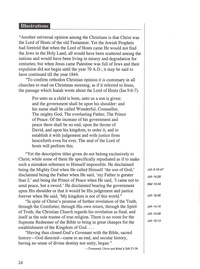
[edit]"Another universal opinion among the Christians is that Christ was the Lord of Hosts of the old Testament. Yet the Jewish Prophets had foretold that when the Lord of Hosts came He would not find the Jews in the Holy Land, all would have been scattered among the nations and would have been living in misery and degradation for centuries; but when Jesus came Palestine was full of Jews and their expulsion did not begin until the year 70 A.D.; it may be said to have continued till the year 1844.
"To confirm orthodox Christian opinion it is customary in all churches to read on Christmas morning, as if it referred to Jesus, the passage which Isaiah wrote about the Lord of Hosts (Isa 9:6-7). For unto us a child is born, unto us a son is given: and the government shall be upon his shoulder: and his name shall be called Wonderful, Counsellor, The mighty God, The everlasting Father, The Prince of Peace. Of the increase of his government and peace there shall be no end, upon the throne of David, and upon his kingdom, to order it, and to establish it with judgement and with justice from henceforth even for ever. The zeal of the Lord of hosts will perform this.
"Yet the descriptive titles given do not belong exclusively to Christ, while some of them He specifically repudiated as if to make such a mistaken reference to Himself impossible. He disclaimed being the Mighty God when He called Himself 'the son of God;" disclaimed being the Father when He said, 'my Father is greater than I;' and being the Prince of Peace when He said, 'I came not to send peace, but a sword.' He disclaimed bearing the government upon His shoulder or that it would be His judgement and justice forever when He said, 'My kingdom is not of this world."
"In spite of Christ's promise of further revelation of the Truth, through the Comforter, through His own return, through the Spirit of Truth, the Christian Church regards his revelation as final, and itself as the sole trustee of true religion. There is no room for the Supreme Redeemer of the Bible to bring in great changes for the establishment of the Kingdom of God....
"Having thus closed God's Covenant with the Bible, sacred history-God directed-came to an end, and secular history, having no sense of divine destiny nor unity, began." -Townsend, Christ and Bahá’u’lláh 27-28
Joh 5:18-47
Joh 14:28
Mat 10:34
Joh 18:36
Joh 14:16
Joh 14:28
Joh 16:13
[Page 25]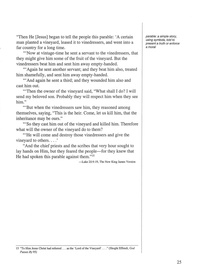 "Then He [Jesus] began to tell the people this parable: 'A certain man planted a vineyard, leased it to vinedressers, and went into a far country for a long time.
"Now at vintage-time he sent a servant to the vinedressers, that they might give him some of the fruit of the vineyard. But the vinedressers beat him and sent him away empty-handed.
"Again he sent another servant; and they beat him also, treated him shamefully, and sent him away empty-handed.
"And again he sent a third; and they wounded him also and cast him out.
"Then the owner of the vineyard said, 'What shall I do? I will send my beloved son. Probably they will respect him when they see him.'
"But when the vinedressers saw him, they reasoned among themselves, saying, 'This is the heir. Come, let us kill him, that the inheritance may be ours.'
"So they cast him out of the vineyard and killed him. Therefore what will the owner of the vineyard do to them?
"He will come and destroy those vinedressers and give the vineyard to others...."
"And the chief priests and the scribes that very hour sought to lay hands on Him, but they feared the people—for they knew that He had spoken this parable against them."15
parable: a simple story, using symbols, told to present a truth or enforce a moral
-Luke 20:9-19, The New King James Version
15 "To Him Jesus Christ had referred... as the 'Lord of the Vineyard'...." (Shoghi Effendi, God Passes By 95)
[Page 26]
Further Study
[edit]Select one of the passages from the "Readings" section. What does the passage say? In what specific ways can this passage be applied in your life?
Personal Reflection
[edit]List any unanswered questions about the lesson you may want to explore in more depth. Use the index on page 83 and the additional reading below to help you find answers to your questions.
Remaining Questions
[edit]1. 2. 3. 4.
Additional Reading
[edit]Gleanings, by Bahá’u’lláh, 46-136 Tablets of Bahá’u’lláh, by Bahá’u’lláh, 47-54 Passages on God and His Manifestations, and Bahá’u’lláh’s station in relation to both.
God Passes By, by Shoghi Effendi, Chapter VI The Guardian's description of the station of Bahá’u’lláh.
The Revelation of Bahá’u’lláh, Vol. IV, by Adib Taherzadeh, 125-44, 406-09
Commentary, with quotations, on the station of Bahá’u’lláh.
[Page 27]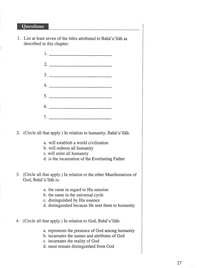
Questions
[edit]1. List at least seven of the titles attributed to Bahá’u’lláh as described in this chapter: 1. 2. 3. 4. 5. 6. 7.
2. (Circle all that apply.) In relation to humanity, Bahá’u’lláh: a. will establish a world civilization b. will redeem all humanity c. will unite all humanity d. is the incarnation of the Everlasting Father
3. (Circle all that apply.) In relation to the other Manifestations of God, Bahá’u’lláh is: a. the same in regard to His mission b. the same in the universal cycle c. distinguished by His essence d. distinguished because He sent them to humanity
4. (Circle all that apply.) In relation to God, Bahá’u’lláh:
a. represents the presence of God among humanity
b. incarnates the names and attributes of God
c. incarnates the reality of God
d. must remain distinguished from God
[Page 28]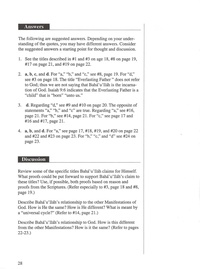
Answers
[edit]The following are suggested answers. Depending on your understanding of the quotes, you may have different answers. Consider the suggested answers a starting point for thought and discussion.
1. See the titles described in #1 and #3 on age 18, #8 on page 19, #17 on page 21, and #19 on page 22.
2. a, b, c, and d. For "a," "b," and "c," see #8, page 19. For "d," see #3 on page 18. The title "Everlasting Father" does not refer to God; thus we are not saying that Bahá’u’lláh is the incarnation of God. Isaiah 9:6 indicates that the Everlasting Father is a "child" that is "born" "unto us."
3. d. Regarding "d," see #9 and #10 on page 20. The opposite of statements "a," "b," and "c" are true. Regarding "a," see #16, page 21. For "b," see #14, page 21. For "c," see page 17 and #16 and #17, page 21.
4. a, b, and d. For “a," see page 17, #18, #19, and #20 on page 22 and #22 and #23 on page 23. For "b," "c," and "d" see #24 on page 23.
Discussion
[edit]Review some of the specific titles Bahá’u’lláh claims for Himself. What proofs could be put forward to support Bahá’u’lláh's claim to these titles? Use, if possible, both proofs based on reason and proofs from the Scriptures. (Refer especially to #3, page 18 and #8, page 19.)
Describe Bahá’u’lláh's relationship to the other Manifestations of God. How is He the same? How is He different? What is meant by a "universal cycle?" (Refer to #14, page 21.)
Describe Bahá’u’lláh's relationship to God. How is this different from the other Manifestations? How is it the same? (Refer to pages 22-23.)